by Carole Epp | Jul 26, 2007 | Uncategorized
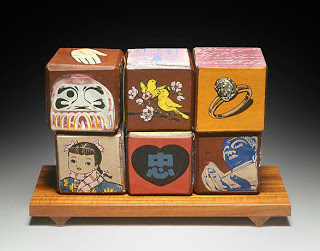
What seems like a long, long time ago as an undergrad student I ran across the work of Scott Rench in an issue of Ceramics Technical and was blown away by his silkscreening technique of getting imagery onto clay. Before leaving school I got a crash course, literally an hour or so, on how to expose a screen and then I was off and running. Well not really. I quickly discovered how difficult it was to properly expose a screen without the proper equipment and my attempts were admitedly quite pathetic. In the end the direction of my work has lead me down other paths which haven’t required a thorough knowledge of printmaking techniques for clay. But I’m still quite a fan of artists who find the means to eloquently incorporate two dimensional imagery into three dimensional (or two dimensional) clay.
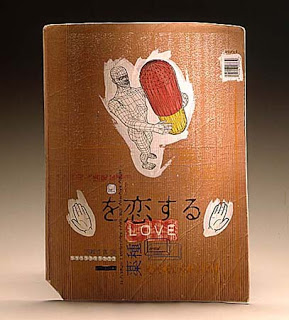
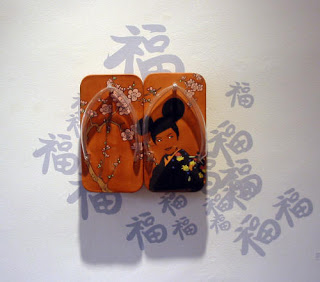
Scott Rench’s art has changed quite a bit since I first ran across his work. But his interest in combining new technology and the computer in his process has been a constant. It’s an interesting mix to take such a tactile maliable material that has such a long history and to combine it with new technology that changes quicker than most of us can keep up with and which is also so dramatically different than working in clay, your maliable material being pixels, zeros and ones.
But I think more and more the computer is invading the studio, either as a tool at our disposal for sketching and developing ideas, for manipulating imagery, for accounting and marketing, recording, storing digital images of our work, and for branching out, communicating with and developing our community. The more I think about it the more I realize that I would be as lost without my computer as I would be without my kiln.
In a more recent series of pieces Scott has worked directly with imagery taken from the computer itself and incorporated with other symbolic imagery to create sometimes complex and other times straight to the point statements about contemporary culture.
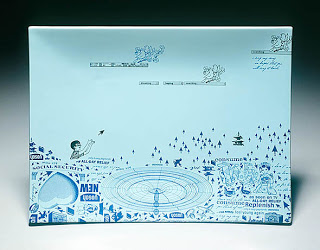
Check out the Dubhe Carreno Gallery for more images of Scott’s and other great ceramic artists.
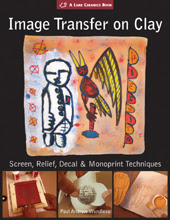
Recently Lark Books also published a book on Print and Ceramics. I have yet to get a copy, but have had a good browse at the book and it looks great. As always Lark fills it with yummy full color photos and the work they’ve chosen is really exciting and contemporary. Lots of different techniques are covered.
But of course the printmaking bible to me will always be Paul Scott’s book Ceramics and Print.
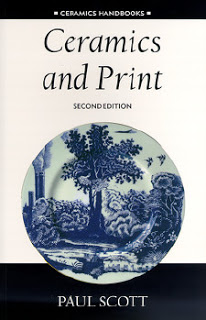
A few years back I while I was still a student in Australia I got the amazing opportunity to volunteer with the ANU’s Distance Ceramics Program (an amazing program for artists who want to work part time yet still acquire a degree – I’ll post more info in a later blog.) Paul Scott was one of the instructors for that particular distance school and I got to sit in on the workshop. While I had read his book prior to that, it was amazing to see the techniques first hand and many techniques which had seemed complex became quite straight forward it the end. Beyond that Paul was an amazingly talented, hilariously funny and generous artist, willing to share all of his trade secrets. And the poignant nature of his subversive work has always interested me.
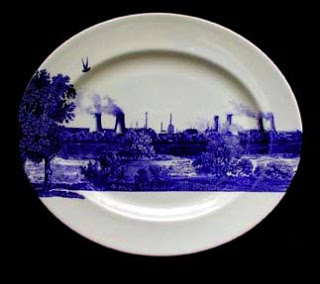
There is a quote from Paul Scott’s catalogue Remember me when this you see which I returned to quite a bit when working on my thesis work with the figurine sculptures. It spoke to what I was trying to accomplish through my own work, the feeling that we are an intricate part of the greater narrative at all times, whether we are aware of it or not. It says:
“I like to make work that provokes some reaction or thought, work that is more than superficial. The issues I deal with are the ones I come across in my everyday life, sometimes close to home, like foot and mouth, or Sellafield, sometimes further away like Israeli bombing of refugee camps, or US treatment of prisoners. But even these far away issues are close to home because we buy Israeli fruit and veg in our supermarkets, we are or can be complicit in these things. I want people to think…”(Dahn, Jo. Remember me when this you se. Ceramics by Paul Scott and from the University of Wales, Aberystwyth and Cereddigion Museum Catalogue Essay.)
Another great site to check out for interesting work with print and ceramics is Robert Dawson’s Website Aesthetic Sabotage (I love the name!). It contains great work with traditional ceramic print imagery manipulated for a contemporary context.
by Carole Epp | Jul 26, 2007 | Uncategorized
It’s always a good day when I get my hands on a new issue of Ceramics Art and Perception. And it’s an even better day when your introduced to a new amazing artist you’ve never heard of before. The work of Danish artist Louise Hindsgavl has completely captivated me.
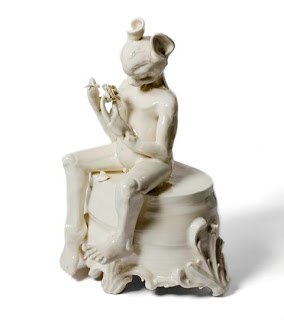
I find this work beautifully rendered and the imagery is rich with political and social commentary. The accompanying article by Tom Jorgensen is a great read, so I won’t ruin it for you by telling you too much, but I love this quote about her work; “Her porcelain figurines break just about every thinkable and unthinkable rule for what we can and can’t do. They emanate violence, mutilation, obscenity and wonderfully coarse humour.” How’s that for a description?
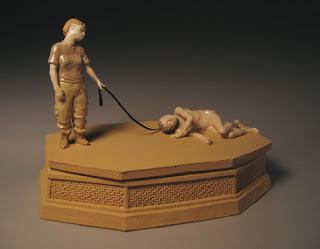
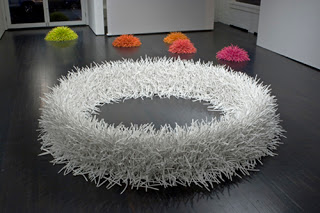
Check out the Nancy Margolis Gallery for more images of her work as well as other greats such as Justin Novak, Bean Finneran, Steve Heinemann, Eva Hild, Annabeth Rosen, Tommi Toija and Sun-Koo Yuh.
Justin Novak
Bean Finneran
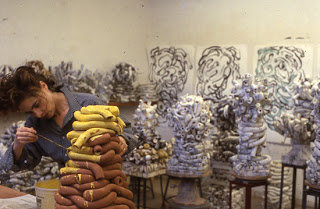
Annabeth Rosen
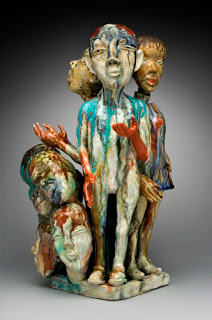
Sun-Koo Yuh
by Carole Epp | Jul 26, 2007 | Uncategorized
Deadline October 1
The Sidney Myer International Ceramics Award in association with La Trobe University was established by Shepparton Art Gallery in 1997 to provide an unprecedented opportunity for a major international ceramic award and exhibition in Australia. This biennale award developed from the Sidney Myer Fund Australia Day Ceramic Award, a national prize established in 1991. The new format award has offered Australian audiences the opportunity to view contemporary ceramic art from around the globe for ten years. The supporting seminar and master-class workshops with the International judge, provide a platform for cross-cultural learning and exchange.
Shepparton Art Gallery was established in 1936 and with the appointment of its first Director in 1970, began collecting Australian ceramics. This collection of Australian and International ceramics now spans over 3000 works and is rated amongst the best ceramic collections in Australia. The gallery’s permanent exhibition highlights the development of this art form, from the first kilns built in Australia through to a contemporary art from around the world. This year the gallery is delighted to announce the inaugural Indigenous Ceramic Art Award to be held in December 2007. This new prize will be a strong counterpart to the gallery’s flagship Sidney Myer International Ceramic Award and each will be held in alternate years.
Download Entry Form
by Carole Epp | Jul 26, 2007 | Uncategorized
The Houston Center for Contemporary Craft Studio Residency Program
Deadline September 1
Program supporting emerging, mid-career, and established artists working in craft media, including but not limited to clay, fiber, glass, metal, and wood. Artists selected for the program will receive a 200–square-foot rent-free studio and a monthly stipend of $400. Studios are naturally lit and equipped with sinks, telephones, and DSL Internet access. The residency length is variable: three, six, or twelve months. Artists will be selected based on the quality of their work and their interest in working at the center and making a difference in Houston’s cultural community. In addition to studio space and stipend, participating artists will have access to a wide variety of resources and opportunities, including teaching opportunities, representation in the HCCC sales gallery, and collaborative opportunities.
Applicants must be able to fulfill a program requirement of twenty-four hours per week spent in their studio during the center’s public hours. For information, contact Amanda Clifford, (713) 529-4848 ext. 104; www.crafthouston.org.
by Carole Epp | Jul 25, 2007 | Uncategorized
Diana Fayt’s blog One Black Bird is one of my regular reads and lately she’s been having guest bloggers, which I think is a brilliant idea. She’s always got insightful posts about her studio practice and related topics and is a great artist and thinker in her own right, but I wanted to bring to light a recent post by guest blogger Laura Zindel as I think it raises a very important issue about “green” ceramics, which I know for me is always in the back of my mind in my own pursuit to be not only a thoughtful consumer in my day to day life, living in the most sustainable means possible, but also finding a way to bring this into my ceramic practice which is by it’s nature not very eco-friendly. It’s a great topic for discussion so I hope you’ll check it out.
by Carole Epp | Jul 25, 2007 | Uncategorized
I think it’s sometimes weird how my attraction to different ceramic styles develops. Some seem to be obvious aesthetics for me to be drawn to and others are sometimes quite far removed from my own working aesthetic that they are almost another language, yet I still find I can acquire inspiration from the whole spectrum of varied styles and processes which make ceramics so unique. I thought this week I’d spend a bit of time introducing some work that I’ve recently fallen in love with, have been inspired by for a while or have had in the back of my mind for years now.
This first artist I just recently discovered via the Toronto Outdoor Art Exhibition’s website which has a great database of participating artists from the last few years. Frederique Bonmatin’s work stood out to me because of the crisp colors and dramatic geometric lines. He’s a potter from Montreal and although his website is in french it’s easy enough to find the gallery section and he does correspond in english if you’re interested in further info about the work.
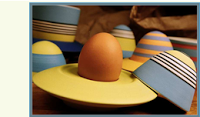
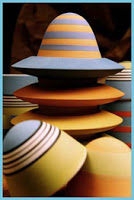
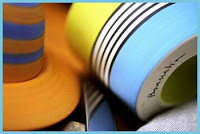
His work also reminds me of the work of Ettore Sottsass whose work I’ve found inspirational since discovering a book on his work at a small used book store in London in 1999. I’m particularly drawn to his Tantra Ceramics from about 1969 which have had an obvious influence on my latest series of functional stoneware. Here’s another website with info and images.
Another artist I came across via the TOAE website is Danny Choi. I just love these “Torso Flasks”
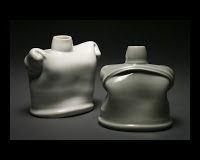
These pieces were developed while Danny was a student at Sheridan and are thrown and altered, creating a beautiful movement with the clay that shows the sensibility of the artist. Here are a few more pieces of Danny’s which I find captivating.
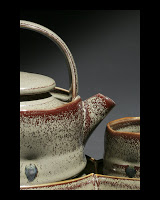
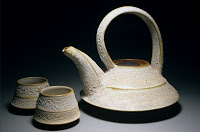
I find in my own work I lean towards the more geometric structured aesthetic as the graceful movement of pliable soft clay often alludes me and when I do try it looks overworked and contrived. Yet from the boldness of colors to the subtlety of traditional celadons and copper glazes, from the drama of geometry and architecture inspired forms to the material properties playing centre stage, I just can’t get enough. It’s all just so darn inspiring!